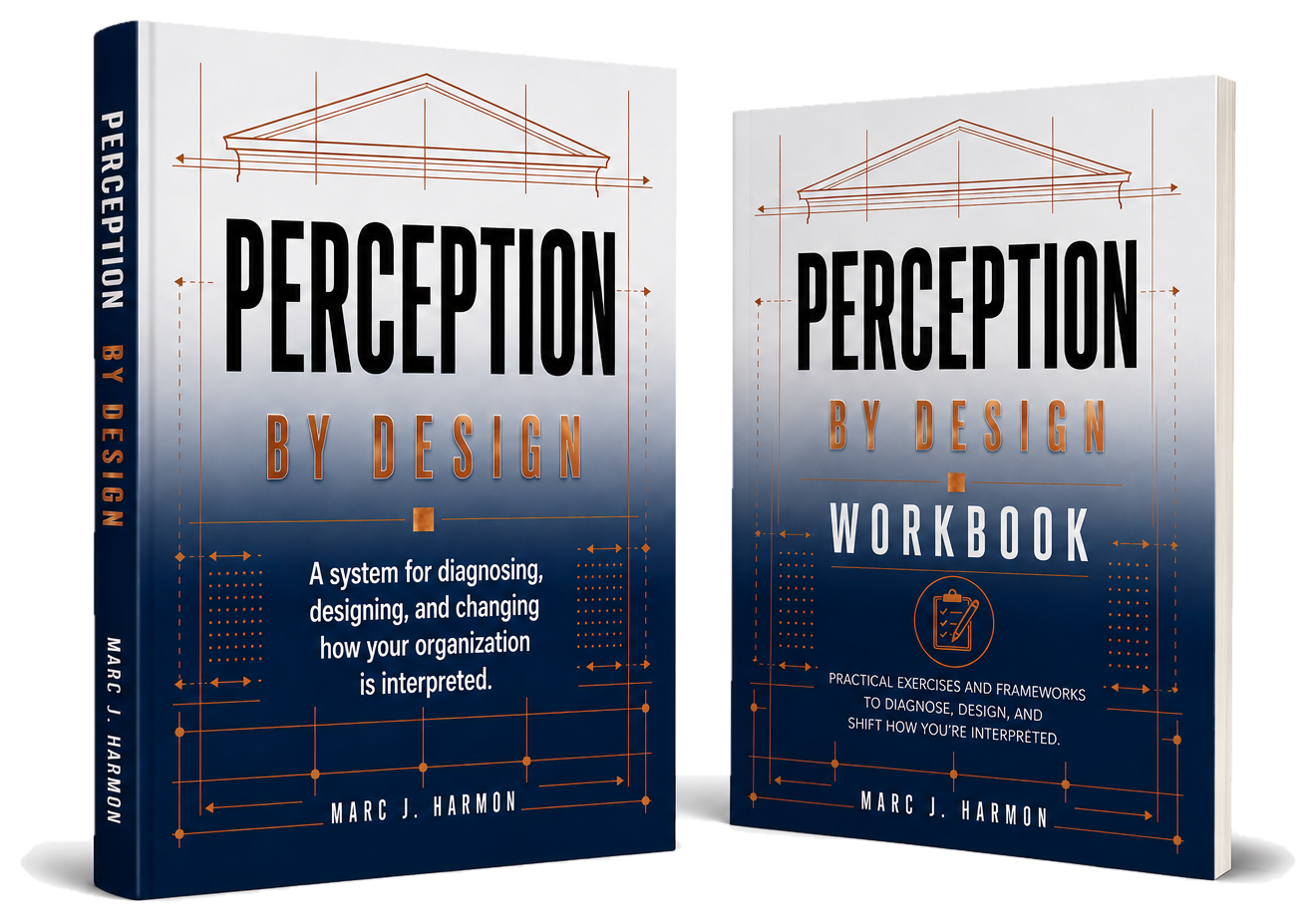
I help organizations diagnose and shape how they are perceived, trusted, and differentiated —
in a world where interpretation and resonance
have become the competitive edge.
There is a gap between what your organization is and what the world believes about it. That gap lives in the space between your strategy and how it is actually interpreted — and it costs your organization credibility, differentiation, and growth every day it goes unaddressed.
The work never starts with the message you want to send. It starts with an honest read of where you actually stand.
Most organizations try to close that gap with better messaging. But perception isn't a messaging problem — it's a belief problem. People don't simply receive your narrative. They filter it through prior assumptions, competing signals, and deeply held frameworks about what is trustworthy and what is not.
In an AI era where content is infinite and communication is increasingly uniform, interpretation has become the last genuine differentiator. I work at the intersection of behavioral science and strategic narrative to help you align it.
Most consultants prescribe before diagnosing. The Perception Audit inverts this. It starts with evidence — what audiences actually believe, where trust breaks down, how competitors are framing the category — and builds strategy from those findings, not from assumptions. This is the starting point for every meaningful change.
Built on how people actually process information, form trust, and make decisions.
Defining where your organization stands in the competitive landscape and why it matters. Built on audience research and competitive analysis, designed to differentiate where trust and interpretation drive decisions.
Developing the story that positions you clearly in the minds of the right people — not just what you say, but how your organization is understood, remembered, and repeated by the audiences who matter most.
Frameworks that align how your organization communicates across every channel and audience — ensuring the right message reaches the right people consistently, credibly, and without contradiction.
Positioning individual leaders for public authority and thought leadership. Defining the intellectual framework, voice, and content strategy that makes a leader's perspective recognizable and trusted over time.
Pre-crisis positioning that ensures your organization has a clear, credible narrative before it's needed. Organizations that survive reputational challenges best are those who understood their narrative before the test.
Ongoing strategic counsel for organizations navigating repositioning, trust challenges, growth transitions, or a market shifting faster than their story. Available as a retainer or project-based engagement.
You build tools with genuine impact. But in a market of lookalikes, your differentiation lives in your head, not in the mind of your buyer. Perception is where deals are won and churn quietly begins.
The story lives in you. The business needs it to live beyond you. Translating founder vision into a narrative the whole organization can carry is harder than most founders anticipate — and more consequential than most realize.
You compete for trust and donor dollars against organizations with larger budgets and louder voices. Perception isn't a marketing problem — it's your fundraising strategy, whether you treat it that way or not.
You serve donors, participants, and community partners who each bring different expectations. A narrative that aligns all three — without diluting any of them — is a precision problem most faith-based organizations haven't solved.
You know what you think. You're less certain the right people think of you when it matters. Building intellectual authority is a long game, and it requires a clear framework before it requires more content.
Saying you've changed isn't the same as being believed. The distance between "we've turned the page" and "we believe you" is a perception problem, not a messaging one.
The depth and scope of each phase scales to the engagement. Not every project requires all four steps.
A rigorous audit of how your organization is currently perceived — through audience research, competitive analysis, and stakeholder interviews. No assumptions.
Defining where you stand, what you mean, and why it matters — built on findings and grounded in the behavioral science principles that govern belief and trust.
Translating strategy into a clear, compelling narrative and messaging architecture that aligns your organization across every channel and audience.
Equipping your team with the frameworks and guidelines to activate the strategy consistently — so the right message reaches the right people, every time.
Marc Harmon — Founder & Principal
Most perception problems aren't communication failures — they're belief failures. I work at that level.
With a background in psychology and strategic communications, I bring a perspective most brand consultants don't have: a grounded, research-based understanding of how people actually form beliefs, interpret information, and decide what to trust. That foundation includes military service as a Marine Corps veteran, where I worked in public affairs — an environment where perception strategy isn't a boardroom exercise but an operational necessity with real consequences.
Over the past decade I've applied this lens across sectors — from Department of Defense programs and nonprofits to tech companies and mission-driven organizations — helping them close the gap between what they are and what the world believes them to be.
The result is strategy that doesn't just read well in a presentation. It changes how organizations are understood, valued, and remembered by the people whose belief matters most.
A decade of cross-sector engagements — measured, documented, and built on research.
Developed the company's first formal brand positioning framework and brand health measurement system — moving top-of-mind awareness from 5th to 3rd among key competitors.
Designed and executed stakeholder perception research for a U.S. military installation, then developed strategic communications that measurably improved community engagement and program participation.
Delivered brand strategy and behavioral-science-based communications for faith-based and mission-driven organizations — producing measurable growth in both participation and trust.
Let's begin with a conversation about what the world should understand about your organization — and what's standing in the way.